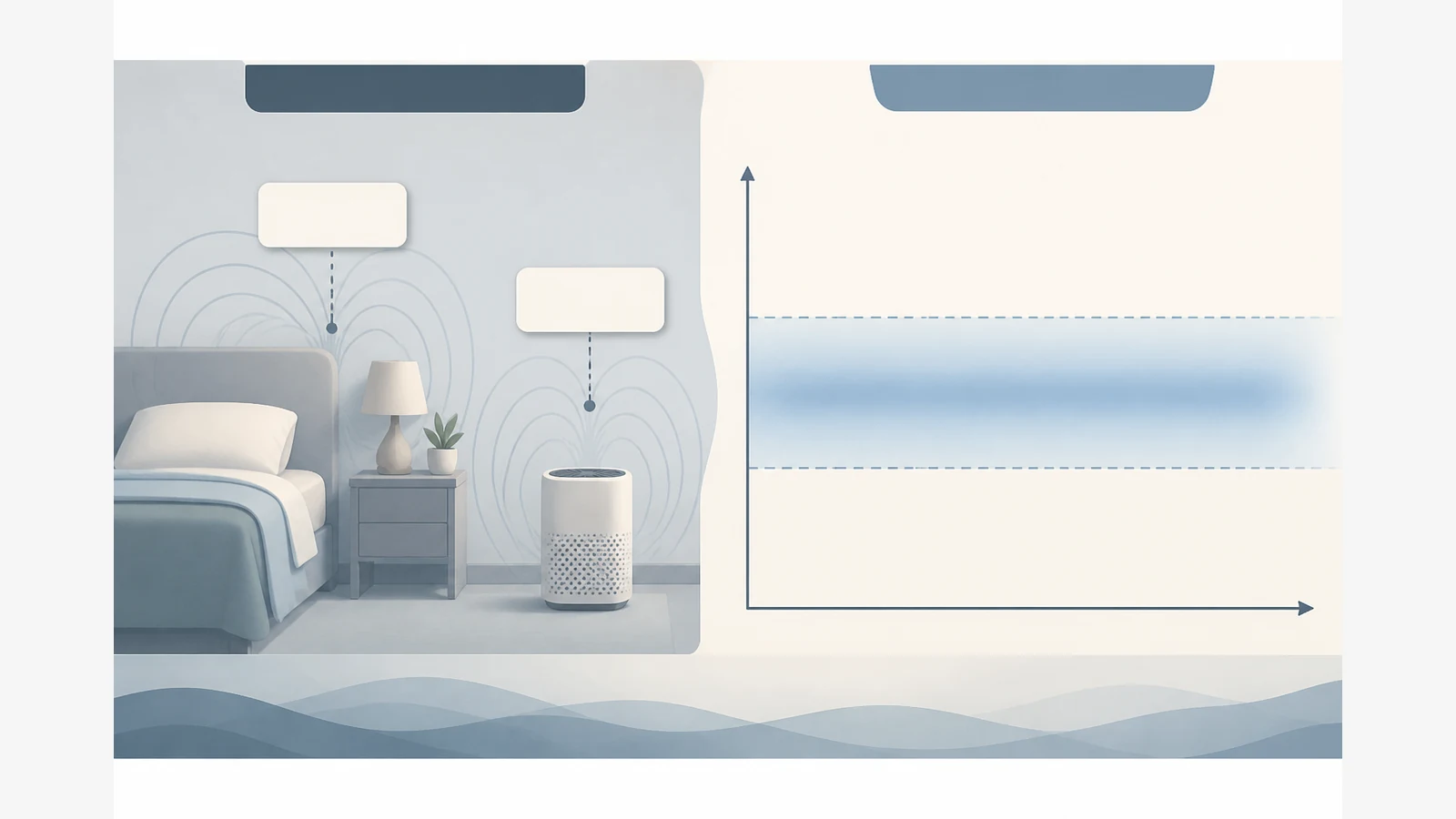
Compare Home Magnetic Field To Ukhsa Background
Away from appliances, typical UK home magnetic fields are often described as about 0.01 to 0.2 µT. Use that published background band as context for your notes—not as a personal pass/fail medical label. Measure in magnetic mode away from kit first, then at the bed head, then beside appliances, and keep room, distance and mode in one simple table.
UKHSA’s electromagnetic fields sources page states that background levels in UK homes are usually 0.01 to 0.2 µT when you are not next to appliances. Separately, UK EMF policy materials centre public exposure management on ICNIRP guideline compliance. Handheld consumer readings help you compare spots inside your home; they are not lab-certified compliance certificates.
What the background range is—and is not
- Is: a descriptive average band for ordinary rooms away from kit.
- Is not: a personal health threshold, a diagnosis tool, or proof that one spike means a property fails a legal test.
- Useful for: calming “is this normal?” questions when a bed-head note sits near the published band while a kettle or consumer unit face reads higher up close.
Three-stop comparison path
- Away from kit — Centre of the lounge or hallway, clear of TVs, chargers and the fuse board. Stand still 10–20 seconds in magnetic mode.
- Bed head — Mattress height where a pillow sits. Note nearby wall sockets, phone chargers and under-bed leads.
- Beside appliances — Fridge side, microwave front (door closed, idle vs running if safe to observe briefly), or the consumer unit door from a short distance—not with the cover open.
If stop 1 sits inside or near the 0.01–0.2 µT descriptive band and stop 3 is higher only within centimetres of a motor or transformer, you are seeing the classic domestic pattern UK materials describe: fields rise close to appliances and fall with distance.
Simple note table
| Room | Distance to nearest kit | Mode | µT note | Beside / away |
|---|---|---|---|---|
| Lounge centre | >1 m | Magnetic | Away | |
| Bedroom bed head | Magnetic | |||
| Kitchen appliance face | 0.1–0.3 m | Magnetic | Beside |
Write the unit every time. Mixing µT with RF units from another mode is the fastest way to scare yourself with a meaningless comparison.
How to use the band without over-reading it
- Treat “inside the published away-from-appliances band” as ordinary-context language, not a clean bill of health.
- Treat “higher next to a running appliance” as expected proximity behaviour unless the elevation persists metres away after you step back.
- If a bed-head note stays elevated after you move chargers and extension leads, revisit layout—or book a professional survey if you need formal evidence for a dispute.
Related checks
Buyers comparing rooms near lines or substations can reuse the same magnetic habit with a room-by-room house viewing note sheet. Parents separating router RF from socket magnetism can follow the nursery router distance checklist.
When you want one handheld for magnetic notes plus RF checks in the same walkthrough, see the 3-in-1 meter product page after you have filled the table above.
FAQ
Does a reading above 0.2 µT mean my home is unsafe?
No. The 0.01–0.2 µT figure describes typical background away from appliances. Higher notes close to kit are common and are not, by themselves, a medical verdict.
Can my handheld prove ICNIRP compliance?
No. Compliance assessments use defined methods and instruments. Your meter is for relative household mapping.
Should I average lots of flickering digits?
Prefer a settled note after standing still. Jot a short range if the display moves, rather than chasing every flicker.