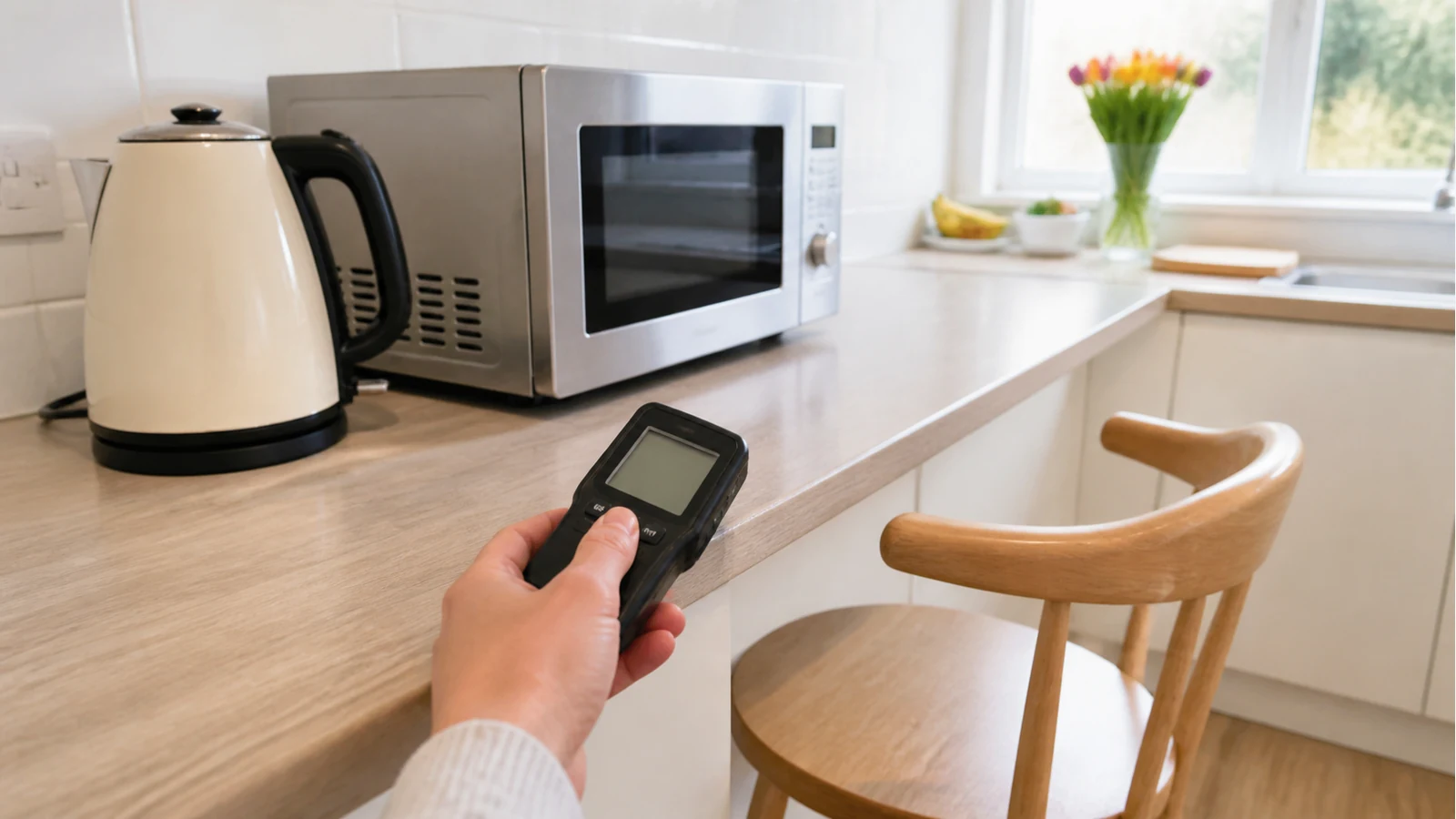
Kitchen Appliance Emf Hotspot Map Uk
Direct answer: Use magnetic-field mode to map close appliance faces and the breakfast-stool line, then label each spot as brief-use or long-sit. A higher reading at a kettle or microwave face is less important than a steady reading where someone sits every day.
Draw the kitchen line
Compact UK kitchens often put stools, bins and prep areas close to appliance sides. Sketch the fridge side wall, microwave front, kettle position, hob edge, boiler cupboard if present and the seat where someone waits with a cup of tea.
Fifteen-minute sequence
- Start with everything idle and measure the seating line first.
- Measure fridge side and front, keeping the meter at the same height.
- Measure the kettle area during a normal boil, then step back to the standing position.
- Measure the microwave front only while following the maker clearances and never treating the meter as a leakage tester.
- Measure the hob edge, but note that induction hob behaviour may sit outside what a simple consumer EMF meter can usefully characterise.
- Mark each point as brief-use, pass-by or long-sit.
Both UKHSA and ENA materials support the practical rule: home appliance fields are usually strongest close to the appliance and fall with distance. Your map should therefore prioritise where people linger.
What the map can and cannot tell you
The map can show whether a stool, pet bed or high chair sits in a close-in hotspot. It cannot certify a microwave, assess medical implants, or prove that a kitchen appliance is causing symptoms. For those questions, use the appliance maker, clinician or qualified professional route.
When a meter is useful
If you want to compare kettle, fridge wall, microwave area and seating line with the same method, a handheld meter can make the map repeatable. Review the RDINSCOS product page only if you need that repeated comparison rather than a one-time layout tidy.